
Introduction on Complex Relationship Patterns
Vedic astrology often reveals deep-rooted karmic patterns that influence an individual’s emotional life, choices, and relationship dynamics. This case study examines the horoscope of a Chinese woman with remarkable beauty and charisma. Her life is characterized by multiple relationships. She has experienced recurring break-ups and has made unconventional partner choices over time.
Despite sincere emotional involvement and repeated efforts to sustain long-term bonds, her relationships have consistently ended in separation. Most recently, she sought guidance regarding a relationship with a partner significantly younger than her, prompting a detailed astrological examination.
To maintain strict confidentiality, no personal identity is disclosed. Only birth details are shared exclusively for astrological analysis.
Birth Details (For Astrological Study Only)
- Date of Birth: 04 July 1983
- Time of Birth: 04:05 AM
- Place of Birth: Xuancheng, China

Key Relationship Indicators in the Rashi (D-1) Chart
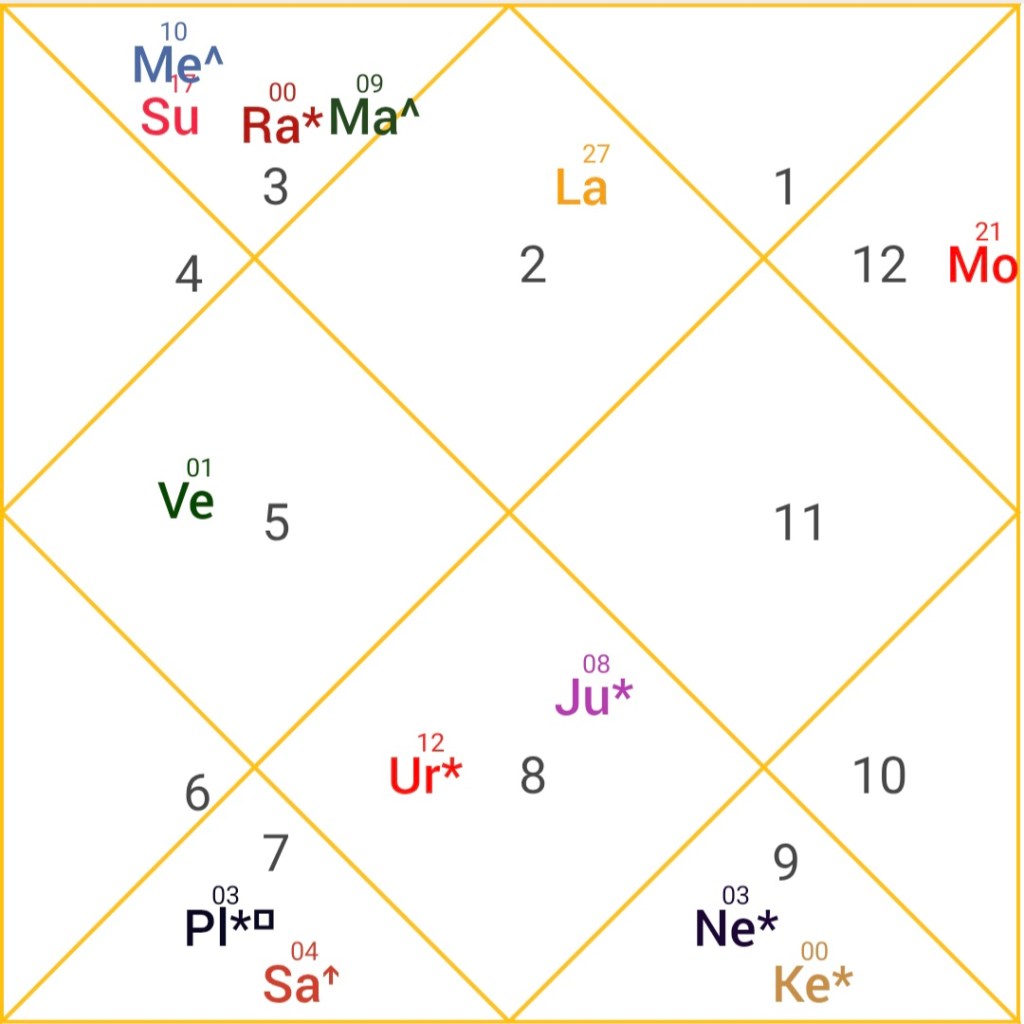
1. Ascendant Lord Venus: Desire Meets Instability
Venus is the ascendant lord. It is placed in the sign of the Sun and the nakshatra of Ketu. This links it directly to the 2nd and 8th houses.
- The Sun (2nd lord) mutually aspects Ketu in the 8th house. This creates a strong connection between family values and intimacy. It also links secrecy and emotional detachment.
- This combination often produces intense attractions followed by dissatisfaction or sudden endings.
2. Affliction of the 7th House (Relationship House)
Saturn is placed in the 6th house in Venus’s sign. It aspects the 8th house and Ketu. This forms a Paap Kartari Yoga around the 7th house.
- This means the house of partnership is surrounded by negative influences. This leads to conflict, delays, emotional strain, and repeated break-ups in relationships.
3. Jupiter as 8th Lord in the 7th House: Partners of Varying Ages
Jupiter, lord of the 8th house, occupies the 7th house in the sign of Mars and nakshatra of Saturn.
- Mars represents youth and passion, while Saturn represents age and maturity.
- This dual influence clearly indicates relationships with both younger and older partners across different phases of life.
4. Strong Rahu Influence: Secretive & Unconventional Bonds
The 7th lord Mars sits in the 2nd house with Mercury (2nd lord). The Sun (4th lord) is also there. They are all in Rahu’s nakshatra and in conjunction with Rahu.
- These planets collectively aspect the 8th house, the domain of hidden affairs, emotional intensity, and separation.
- Rahu’s involvement amplifies non-traditional relationships and secrecy, often leading to instability.
5. Jupiter’s Extensive Influence: Repetition Without Fulfilment
From the 7th house, Jupiter aspects:
- The 3rd house
- The Moon (3rd lord) in the 11th house
- Through retrograde motion, the 12th house and 2nd house
This creates repeated opportunities for intimacy and emotional bonding. However, Jupiter (the 8th lord) is afflicted and placed in Mars’s sign. It fails to provide stability in man-woman relationships. This results in recurrent break-ups despite genuine effort.
Confirmation from the Navamsha (D-9) Chart
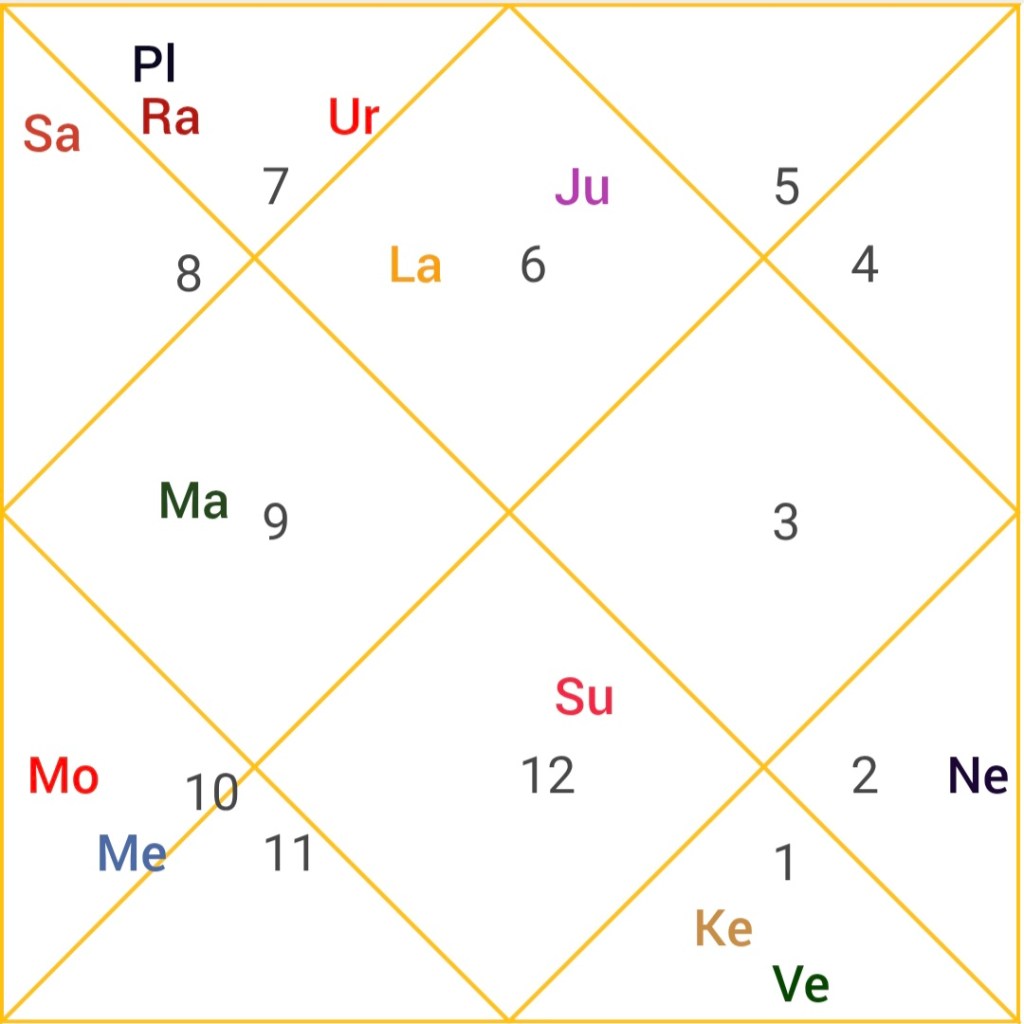
6. Sun in the 7th House: Ego & Disharmony
In the Navamsha chart:
- The 7th lord Jupiter mutually aspects the 12th lord Sun, which is placed in the 7th house.
- The Sun in the 7th house often brings ego clashes, dominance issues, and imbalance in partnerships.
- Malefic Mars (8th lord) aspects the Sun, reinforcing instability.
7. Repeated Mars Influence: Younger Partners
From both the Moon sign in the Rashi chart and the Navamsha chart, Mars aspects the 7th house. This aspect again points toward younger partners and relationships driven by passion rather than longevity.
8. Venus in the 8th House (Navamsha): Intense Desires
Venus placed in the 8th house in the sign of Mars highlights:
- Strong attraction toward intense, private, and unconventional relationships
- A preference for emotionally charged bonds, often with younger partners
9. Scorpio Emphasis: Secret Life & Long-Term Patterns
From Venus, Saturn occupies the 8th house in Scorpio, a sign associated with secrecy, transformation, and deep emotional experiences.
- Scorpio’s natural connection to the 8th house brings a unique influence. Its placement affects the 7th house of the Rashi chart. This indicates a persistent pull toward hidden or unconventional relationships that begin early in life.
Role of Planetary Periods (Yogini Dasha)
Throughout her life, the running Yogini Dashas of Rahu, Moon, Sun, Jupiter, Mars, Mercury, Saturn, and Venus have been active. They have continuously activated these patterns. These are all directly linked to relationship houses.
The result:
- Multiple relationships
- Strong emotional involvement
- Repeated endings and emotional exhaustion
Despite sincere intentions, the final outcome consistently points toward separation.
Present Relationship Outlook
The same planetary combinations indicate that the current relationship with a significantly younger partner faces challenges. It is under severe strain. It is nearing collapse, following the same karmic pattern seen earlier.
Conclusion
This case study demonstrates how complex relationship patterns can be clearly foreseen. Age-gap attractions, emotional intensity, secrecy, and repeated break-ups are also detectable. This is achieved through systematic Vedic astrological analysis. It is especially effective when both Rashi and Navamsha charts are examined together.
Such intricate life patterns cannot be understood through surface-level observation alone, but require deep astrological insight and experience.
About the Astrological Consultation
For personal, confidential, and fee-based relationship analysis,
Relationship Counselor & Astrologer Siddhartha Goell

WhatsApp: +91-7827020780
Disclaimer
This astrological case study is presented purely for educational and explanatory purposes.
No individual should correlate this analysis with any real person or situation beyond astrological study.
 Astrology: what do stars foretell